
Company check before you pay the advance.
A good website takes a week. Two years of filed accounts, real employees and no tax debt do not.
The advance is where risk moves entirely to your side. One lookup shows how long the company has existed, who runs it and what they left behind.
60 checks included · cancel anytime
What a company that should not get a 30% advance looks like.
- Incorporated weeks ago, with no accounts ever filed.
- Share capital of 200 RON against a contract worth tens of thousands.
- A registered office shared with hundreds of other companies.
- A director with one struck-off and one insolvent company behind them.
- Current tax debt, or cases opened by other suppliers.
No single signal is illegal. Together they answer “do I pay 30% up front?” better than a pitch does.
A check is not a yes or no. It is an informed negotiation.
Cut the advance
Or tie it to deliverables, in tranches.
Ask for security
A promissory note or performance guarantee.
Start small
A first order at a value you could afford to lose.
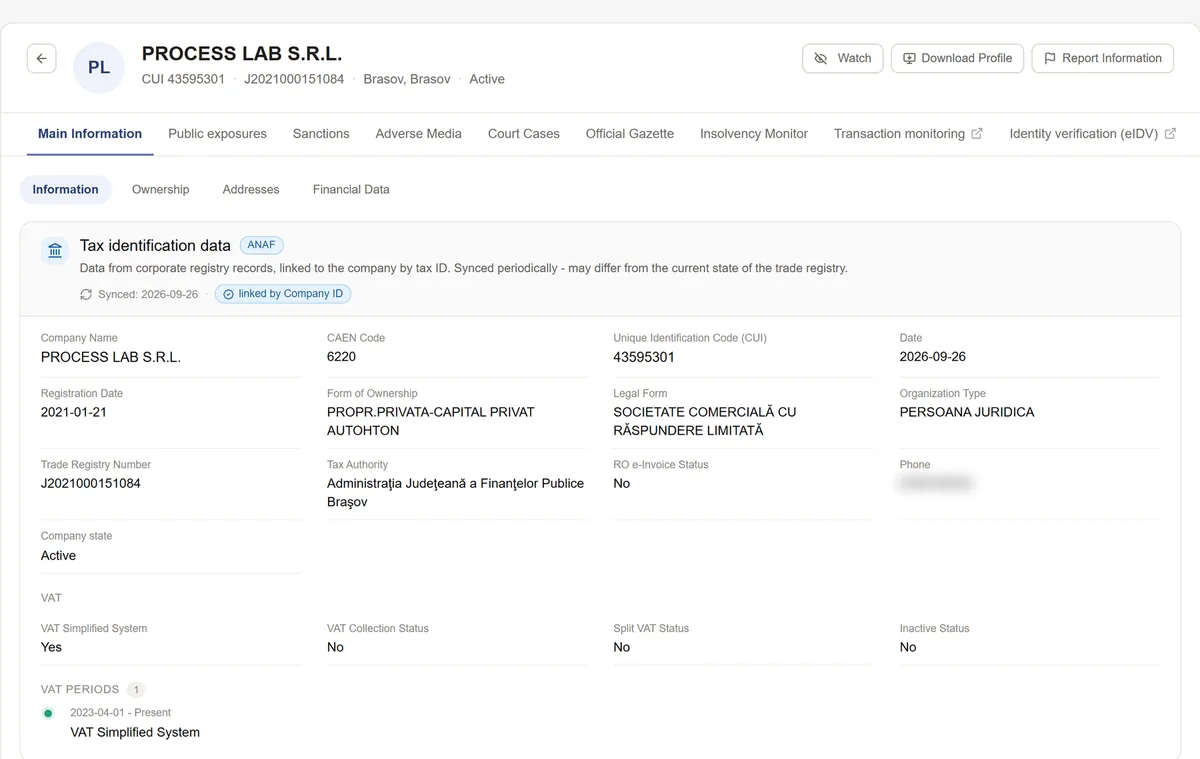
What the report looks like.
Everything about age, capital, directors and obligations, before you wire the money.
Frequently asked questions.
Seconds. Enter the name or the registration number and the full profile comes back on one page, with no five portals and no manual exports.
That it is recent, and not much more. A three-month-old company has filed no accounts, has no litigation history and cannot have old debt. That does not make it bad, but it means the advance rests on your judgement rather than on a track record. The report gives you the incorporation date, the share capital and who runs it, including what other companies that director has had.
Yes. The public sources are re-queried every day, and a company profile updates as the registers publish changes. Each section of the report states the moment it reflects, so you always know how fresh the information is.
Nothing stops abruptly: credits are topped up inside the platform, and if you keep hitting the limit you move to a larger plan: Basic carries 400 credits, Pro 800. One credit is one check and is spent only when you actually run one, so the cost follows real activity.