
How your company looks in public data.
When you ask for credit, or simply a larger contract, the other side looks at the same public registers.
Nobody asks you about an old case or a line in the Official Gazette. They look, they conclude, and they adjust the terms.
60 checks included · cancel anytime
Five registers, the same for everyone.
- ANAFOutstanding obligations to the state budget.
- Portal.JustCases your company is party to.
- BPIPayment incidents and insolvency proceedings.
- ONRCShareholders, directors, capital, filed accounts.
- Official GazettePublished filings about the company.
What gets read without anyone asking you.
- Debt on contributions: read as a liquidity problem, not a dispute.
- A case still visible, even one settled, raises a question you never answer.
- A stale registered office or old filings: read as administrative disorder.
- Frequent changes of director or ownership.
Most of it has a simple explanation. It just never reaches the analysis unless you know someone is looking.
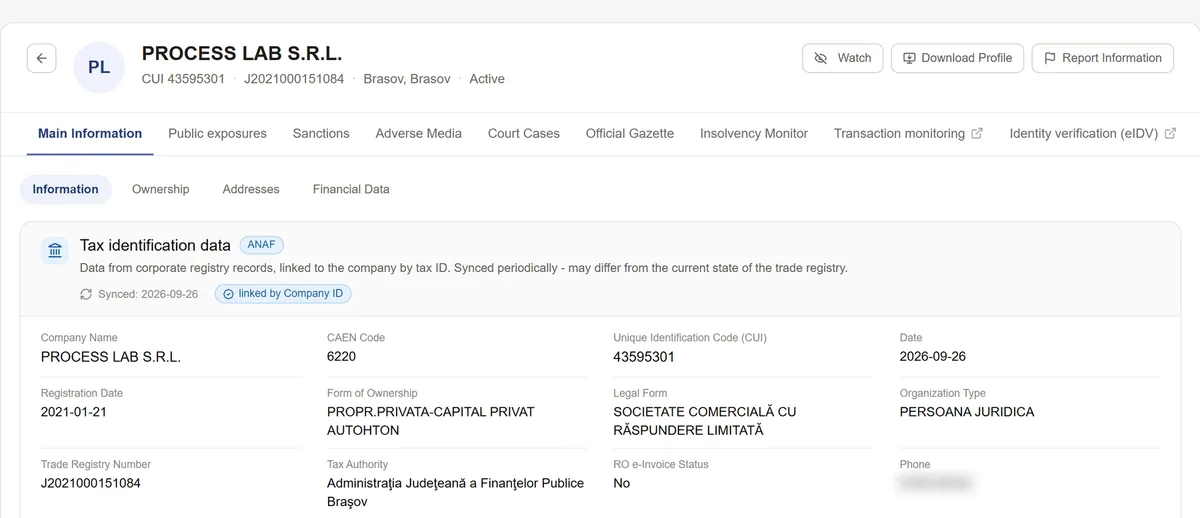
What the report looks like.
Your company public profile, read from the same registers the other side reads it from.
Frequently asked questions.
You see the same public registers the picture is built from: ANAF, ONRC, Portal.Just, the Official Gazette and the insolvency bulletin. A bank layers its own data on top: your credit history, account turnover, its internal scoring. The public layer, though, is identical, and it is the only one you can put right before the meeting.
Not through us: we do not hold the data, we only read it from the registers. Corrections happen at the source: a wrong filing is fixed at ONRC, an obligation you have paid but that still shows is cleared with ANAF. The report is useful precisely because it tells you what to fix and where, before someone else asks about it.
Yes. The public sources are re-queried every day, and a company profile updates as the registers publish changes. Each section of the report states the moment it reflects, so you always know how fresh the information is.
Nothing stops abruptly: credits are topped up inside the platform, and if you keep hitting the limit you move to a larger plan: Basic carries 400 credits, Pro 800. One credit is one check and is spent only when you actually run one, so the cost follows real activity.